
Blog
How to Insure Antique Furniture: The Appraisal Documentation Insurers Require
Insuring antique furniture at full replacement value starts with a formal appraisal that carriers will actually accept for scheduling. This guide breaks down the exact documentation, from item identification to a signed value conclusion, that insurers expect before they'll add a piece to your policy.
A standard homeowner's or renters' policy caps payouts on individual items, and antique furniture almost always exceeds that cap. If a 19th-century mahogany secretary or a set of Federal-period chairs burns in a house fire, the insurer isn't going to hand over what it would actually cost to replace them unless you did the paperwork first. That paperwork is a formal appraisal, and carriers are specific about what it needs to contain.
What Does It Mean to "Schedule" Antique Furniture on a Policy?
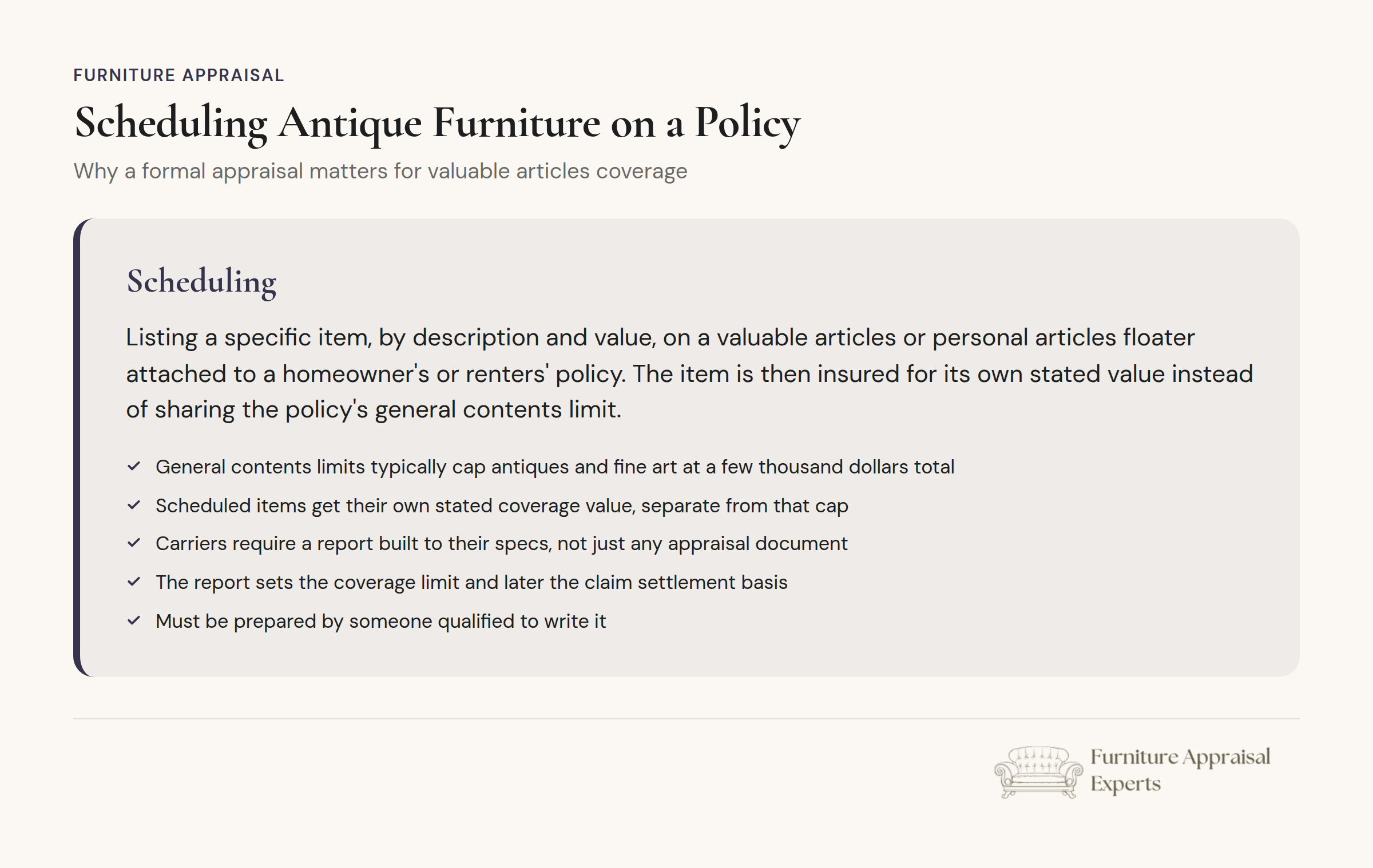
Scheduling means listing a specific item, by description and value, on a valuable articles or personal articles floater attached to your homeowner's or renters' policy. Once an item is scheduled, it's insured for its own stated value rather than folded into the policy's general contents limit, which typically caps categories like antiques and fine art at a few thousand dollars total.
Most carriers won't schedule an item without a supporting appraisal, and they won't accept just any document that calls itself one. They want a report built to their specifications, prepared by someone qualified to write it, because that report becomes the basis for the coverage limit and, later, for any claim settlement. If you've never had a piece formally appraised before, our online furniture appraisal service walks through what that process looks like from submission to signed report.
What Documentation Do Insurance Carriers Require in the Appraisal?
A carrier-ready appraisal identifies the piece precisely enough that no other object could be substituted for it, and it states a value with a clear basis. Insurance appraisals are written knowing that people other than the owner will eventually rely on them: an underwriter reviewing the policy, and if a claim is ever disputed, an adjuster or a court. That standard shapes what the report has to include.
A complete report for scheduling antique furniture typically covers:
- Item identification: a specific description (maker or attribution if known, form, and function) that distinguishes the piece from a generic item of the same type.
- Materials and construction: wood species, joinery method, hardware, upholstery, and any finish details that support both authenticity and value.
- Dimensions: height, width, depth, and any other measurements relevant to identifying the exact piece.
- Date or period: the era of manufacture, stated as precisely as the evidence allows, with the reasoning behind that dating.
- Condition report: a factual account of wear, prior repairs, restoration, losses, or damage, since condition drives value as much as age does. Our guide on how furniture condition affects appraisal value covers this in more depth.
- Photographs: clear images of the whole piece and close-ups of maker's marks, joinery, damage, or repairs.
- Provenance and supporting paperwork: prior bills of sale, auction records, family history, or previous appraisals, where they exist.
- A stated value conclusion and its basis: the dollar figure the appraiser concluded, along with the valuation approach used to reach it.
- Appraiser credentials, signature, and date: the appraiser's qualifications, a signed certification, and the effective date of the appraisal.
Carriers lean on this level of detail for a reason. If a claim is ever filed and disputed, the report needs to stand on its own as evidence that the item existed as described and that its value was reasonably supported at the time of inspection.
Pro tip: Ask your appraiser for high-resolution digital photographs alongside the printed report. Some carriers request separate image files during underwriting, and having them ready avoids a delay in getting the item scheduled.
Replacement Value vs. Fair Market Value: Which One Insurers Use
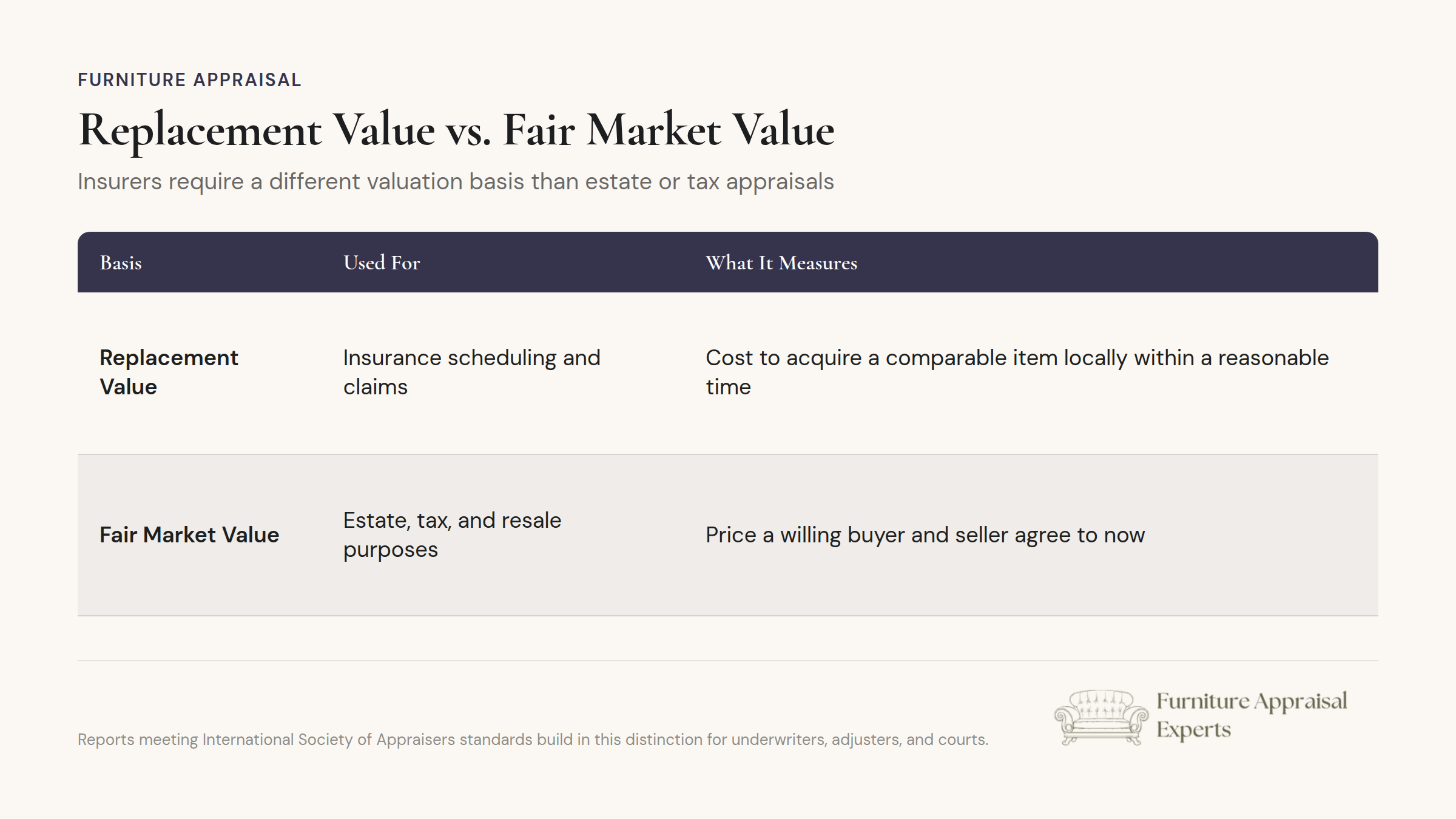
Insurance appraisals for scheduling are written on a replacement value basis, not fair market value. Replacement value is what it would cost to acquire an item of similar age, quality, and craftsmanship in the appropriate marketplace within a reasonable amount of time; fair market value is the price a willing buyer and willing seller would agree to in the current resale market, and it's the standard used for estate, tax, and resale purposes.
The two numbers can differ substantially for antique furniture. A piece with a modest resale market might still cost far more to replace with a comparable period item if suitable pieces are scarce, while a highly collectible piece might carry a resale value close to or even above its replacement cost. Handing an insurer a fair market value appraisal, or an estate appraisal prepared for the IRS, when they need a replacement value figure is one of the most common reasons a scheduling request gets kicked back for revision.
| Basis | Used For | What It Measures |
|---|---|---|
| Replacement Value | Insurance scheduling and claims | Cost to acquire a comparable item in the appropriate marketplace within a reasonable time |
| Fair Market Value | Estate, tax, and resale purposes | Price a willing buyer and seller would agree to in the current market |
When you request an appraisal for insurance, say so up front and confirm the report will state replacement value as its basis. Reports prepared to standards set by the International Society of Appraisers are written with this distinction built in, along with the awareness that the document has to hold up to scrutiny from underwriters and, if it comes to it, adjusters or the courts.
How Much Does an Antique Furniture Appraisal for Insurance Cost?
An antique furniture appraisal is quoted as a fixed fee before work begins, scoped to the piece and the report's intended use. Standard reports typically start from $195, while an advanced report prepared to a higher documentation standard starts from $295, and most single-piece or small-collection engagements fall between $195 and $995. Larger or more complex collections, such as a full estate's worth of period furniture, can run $1,600 to $3,500 or more.
What drives the fee is the scope of the assignment: how many pieces need appraising, how much research the period and maker require, and how detailed the report needs to be for the carrier. It isn't driven by how valuable the furniture turns out to be. A piece's market value affects the number in the report, not what you pay to have the report written.
How Often Should You Update an Antique Furniture Appraisal?
Most carriers expect a scheduled item's appraisal to be refreshed roughly every 3 to 5 years, though this is common industry practice rather than a fixed legal requirement written into insurance regulation. Antique and collectible markets shift, and a value that was accurate five years ago may no longer reflect what it would cost to replace the piece today.
A few events should trigger an earlier update regardless of how recently the item was appraised:
- Restoration or repair work: any conservation, refinishing, or structural repair changes the piece's condition and can change its value in either direction.
- Damage: even minor damage should be documented and reflected in an updated report before it affects a claim.
- A major shift in the market: a sudden surge or drop in demand for a maker, period, or style can move replacement costs faster than a routine review cycle would catch.
Watch out: An outdated appraisal doesn't just risk under-insuring the piece. If a claim is filed years after the last inspection, the insurer may question whether the report still reflects the item's actual condition, which can slow down or complicate the settlement.
Keeping the Paper Trail Ready Before You Need It
The appraisal is only useful to an insurer if it's paired with the rest of the paper trail: the policy schedule listing the item, the photographs on file, and any prior documentation showing the piece's history. Keep copies of the appraisal, the scheduling confirmation from your carrier, and supporting photographs somewhere other than the house the furniture sits in, whether that's a safe deposit box or a secure digital file.
If you're scheduling antique furniture for the first time or your last appraisal predates a move, a restoration, or a few years of market change, our team can prepare a report built specifically for insurance use. Our furniture appraisal process guide explains what to expect from inspection through delivery, and our online furniture appraisal service is the fastest way to get a piece properly documented before it needs to go on a claim.
This article is provided for general informational purposes only and does not constitute legal, tax, or financial advice. Readers should consult a qualified attorney, CPA, or insurance professional regarding their specific circumstances.