
Blog
How to Tell if Antique Furniture Is a Reproduction Before You Buy
Learn how to tell if antique furniture is a reproduction by reading dovetails, saw marks, screws, hardware, and finish together, not any single detail alone. This guide walks through the verifiable tells buyers and sellers use before money changes hands.
Every antiques market has reproduction furniture priced as if it were the real thing, and the gap between a genuine 18th-century chest and a well-made later copy can run into thousands of dollars. Buyers who don't know how to tell if antique furniture is a reproduction can easily overpay, and sellers who misjudge what they own often leave money on the table or unintentionally misrepresent a piece. This guide walks through the construction, hardware, and finish details that separate a period original from a later copy, and where a professional furniture appraisal settles the question when real money is on the line.
What Separates an Antique From a Reproduction?
An antique, in most trade and appraisal contexts, is a piece that is roughly 100 years old or older. A reproduction is a piece made later, in an earlier style, and honestly sold as a reproduction rather than passed off as period work. A fake or "repro" goes a step further: it is built or altered specifically to deceive a buyer into paying antique-level prices for something that isn't.
The distinction matters because none of these categories are inherently bad. A well-made 1920s reproduction of a Chippendale chair can be a fine piece of furniture. The problem is misrepresentation, whether intentional or the result of a seller simply not knowing what they have. Our five signs of a valuable antique guide covers the broader value picture; this article focuses narrowly on the construction and material evidence that tells you which category a piece actually falls into.
Check the Dovetails First: Hand-Cut vs Machine-Cut Joinery
Dovetail joints are one of the most reliable dating tools available, and they're easy to check yourself. Pull out a drawer and look at where the sides meet the front and back.
Hand-cut dovetails, the norm until roughly the late 1800s, are uneven by nature. Each pin and tail was laid out and cut by hand, so spacing varies, the angles aren't identical from one joint to the next, and you can often see faint scribe lines where the cabinetmaker marked the cuts. Machine-cut dovetails, which became common from the late 1800s and early 1900s onward, are the opposite: highly regular, evenly spaced, and essentially identical from joint to joint. Detailed breakdowns of this dating method, including how joint spacing and cut irregularity shifted with industrialization, are widely documented in furniture authentication literature, including analysis of period furniture authentication tells.
A piece marketed as pre-1850 with perfectly uniform machine-cut dovetails on every drawer is telling you something. Either it's a later piece, or the drawers have been replaced entirely.
Read the Saw Marks on Unfinished Surfaces
The backs, bottoms, and undersides of furniture were rarely finished carefully, which makes them useful evidence. Look for the marks left by the saw that cut the boards.
- Straight, linear marks point to a hand saw or pit saw, consistent with earlier, pre-industrial production.
- Curved or arced marks point to a circular saw, which came into wider use with industrial milling and signals later manufacture.
These tool marks are one of the more objective, checkable indicators available to a buyer without special equipment, and general guides on distinguishing authentic furniture from reproductions consistently point to saw mark analysis as a first-pass test. Circular saw marks on a piece claimed to predate the mid-1800s are a contradiction worth investigating further.
Screws and Fasteners Tell a Precise Story
Fasteners are dated with unusual precision, which makes them one of the strongest single tells available. Early hand-made screws have off-center, irregular slots and hand-cut threads that aren't perfectly even along the shaft. Machine-made slotted screws, common from roughly the 1840s and 1850s onward, are uniform, with centered slots and consistent threading.
Phillips-head screws are the clearest hard tell of all. They're a 20th-century development, and their presence anywhere in the original structural joinery of a supposedly period piece is close to conclusive evidence of later manufacture or a significant modern repair. Dealer guides on spotting reproductions single out screw type and fastener dating as one of the fastest checks a buyer can do in the field, since it takes only a screwdriver and a close look.
Watch out: a single replaced screw doesn't condemn a piece. Furniture gets repaired over a long life. What matters is whether the fasteners in the primary structural joints, the ones holding the case together, match the claimed age.
Hardware Weight, Wear, and Hole Patterns
Pulls, escutcheons, and hinges carry their own evidence. Cast brass hardware is thick and heavy, with small mold irregularities and wear patterns that build up unevenly with decades of hand contact. Stamped or pressed brass hardware is thinner, mechanically uniform, and far more common on later or mass-produced pieces.
Check the mounting points as closely as the hardware itself:
- Extra or filled screw holes behind a drawer pull often mean the hardware was swapped at some point, which isn't disqualifying on its own but should prompt more questions.
- Misaligned holes relative to the current hardware suggest a mismatch between the piece and what's currently mounted on it.
- A mismatch between hardware wear and surrounding wood wear (bright, unworn hardware set into wood that shows decades of hand contact, or the reverse) usually means the hardware isn't original to the piece.
Finish and Patina: Where Age Actually Shows
Finish chemistry is one of the more technical tells, but the visual difference is learnable. Traditional shellac ages with fine surface checking, a softer, warmer tone, and a dulling that isn't perfectly even across the surface. Modern lacquer looks harder, more uniform, and more evenly glossy, even when applied to try to mimic an older look.
Patina should tell a consistent story about how the piece was actually used. Genuine old wood oxidizes unevenly: darker where it was exposed to light and air, lighter where it was protected under a drawer runner or behind a door. Wear concentrates exactly where hands and use would have touched the piece over decades, not evenly across every surface. General guides comparing authentic period furniture to reproductions describe this uneven aging and finish pattern as one of the hardest details for a reproduction to fake convincingly, because artificial distressing tends to be applied too symmetrically and too uniformly to pass close inspection.
Pro tip: compare a drawer front's exterior color to the wood just inside the drawer opening, under the runner. A large color difference supports genuine age. Identical color on both surfaces is a warning sign.
Secondary Wood and Plywood: What's Hiding Underneath
Period furniture makers routinely used a better wood on visible surfaces and a cheaper, different wood on hidden components like drawer sides, backs, and case interiors. That mixed-species construction is actually a good sign of age, not a red flag.
What isn't consistent with an early piece is plywood, particleboard, or highly regular machine-cut veneer in a structural role. These materials are 20th-century products, and their presence in the core construction of a piece claimed to be 19th century or earlier is a reliable disqualifier, a point echoed in reproduction-detection guides aimed at buyers walking antique malls and shows, including checklists for spotting reproduction construction. Veneer itself isn't the problem; it was used historically and on genuinely fine period pieces. The core material underneath it, and how evenly it was cut, is what to check. If you're unsure what species you're looking at, our guide on identifying wood type in antique furniture walks through grain, color, and weight differences by species.
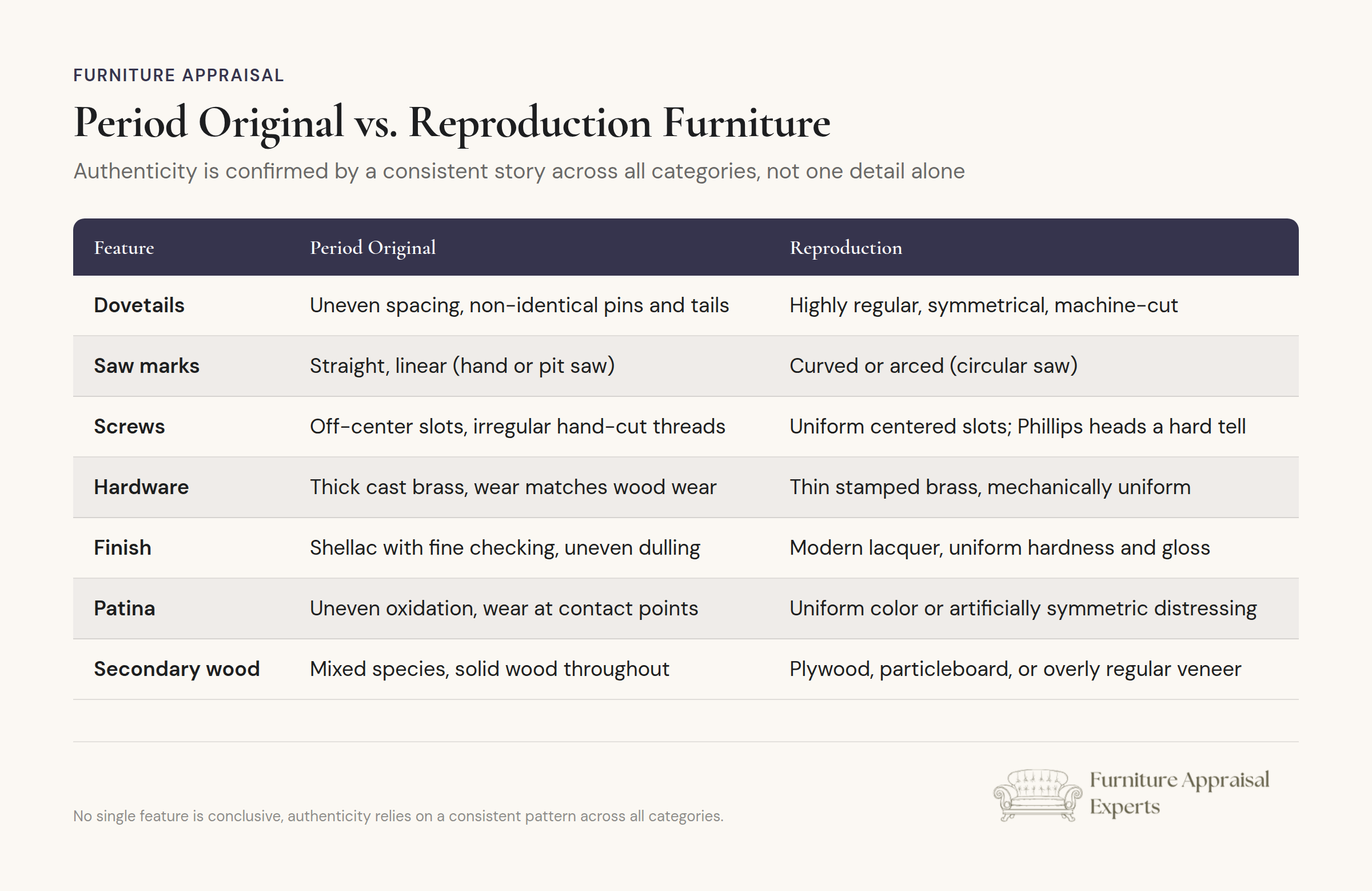
Period Original vs. Reproduction at a Glance
No single detail below is conclusive by itself. Authenticity is established by a consistent story across every category, not by any one column matching perfectly.
| Feature | Period Original | Reproduction |
|---|---|---|
| Dovetails | Uneven spacing, non-identical pins and tails | Highly regular, symmetrical, machine-cut |
| Saw marks | Straight, linear (hand or pit saw) | Curved or arced (circular saw) |
| Screws | Off-center slots, irregular hand-cut threads | Uniform centered slots; Phillips heads are a hard tell |
| Hardware | Thick cast brass, uneven wear matching wood wear | Thin stamped brass, mechanically uniform |
| Finish | Shellac with fine checking, uneven dulling | Modern lacquer, uniform hardness and gloss |
| Patina | Uneven oxidation, wear concentrated at contact points | Uniform color or artificially symmetric distressing |
| Secondary wood | Mixed species, solid wood throughout | Plywood, particleboard, or overly regular veneer core |
Why This Matters for Buying, Selling, or Insuring a Piece
Condition and completeness are among the biggest drivers of value in the antique furniture market, and misidentifying a reproduction as a period original is one of the most common ways a seller overvalues a piece, or a buyer overpays for one. Collectors are generally forgiving of honest repairs and restoration on an original piece; that's normal for furniture that's been in use for a century or more. A piece built entirely as a later reproduction is a different problem altogether, and it should be priced as what it actually is.
This isn't just a pricing courtesy. Selling a reproduction as a genuine antique without disclosure runs into the same unfair and deceptive trade practice standards that govern furniture advertising generally, including federal guidance on misrepresenting a product's age, construction, or condition. If you're the seller, that's a reason to get the identification right before you list a piece. If you're the buyer, it's a reason to ask direct questions and expect a straight answer.
When to Call in a Professional Appraiser
The checks above will get most buyers and sellers most of the way to a confident answer. When the piece is valuable enough that the difference between "period original" and "well-made reproduction" changes the outcome of a sale, an insurance claim, or an estate division, the checks above stop being enough on their own. A formal, USPAP-compliant appraisal combines the same construction and material evidence with market research, comparable sales, and documented reasoning, producing a defensible determination that a buyer, insurer, or court will actually rely on.
If you're weighing whether a piece in your home, an inherited collection, or an item you're about to buy is genuine period work or a later copy, our appraisers can examine it directly and put a documented, defensible value behind the answer.