
Blog
How Furniture Condition Affects Appraisal Value (and What You Can Restore)
Furniture condition affects appraisal value when damage is structural or functional, not when it's a scuff a buyer would overlook. This guide breaks down which flaws lower a valuation, which ones restore cleanly, and how to protect value before you touch a repair.
Every furniture owner asks some version of the same question before an appraisal: will this scratch, this loose joint, or this water ring drag my number down? The honest answer is that it depends on what kind of damage it is, not how it looks at first glance. Some flaws barely register with an appraiser. Others change the value calculation entirely, and repairing them the wrong way can make things worse.
Our online furniture appraisal team gets asked about condition on nearly every assignment, whether the piece is a mid-century dresser or a Federal-era sideboard. This guide covers how condition actually factors into a valuation, which problems are usually restorable without hurting value, and which ones tend to keep a number depressed no matter what you do to fix them.
How Does Furniture Condition Affect Appraisal Value?
Condition lowers appraised value when it causes structural weakness, lost function, or visible deterioration that a buyer would have to pay to fix. It generally does not matter when the issue is cosmetic clutter or minor surface wear that any reasonable buyer would overlook. Appraisers separate the two categories deliberately, because treating every mark on a piece as a value hit would make no sense against how the actual market behaves.
In a furniture or FF&E valuation, an appraiser inventories each item, then adjusts the value for age, construction quality, and condition before landing on a final figure. Worn, damaged, or structurally compromised pieces carry lower market value and higher expected repair costs, and that gets reflected directly in the report, according to industry guidance on secondhand furniture pricing. This is different from a real estate appraisal, where furniture in the home is largely irrelevant. In that context, appraisers are valuing the property itself, and ordinary decorating or a bit of household clutter typically has no bearing on the number at all, per reporting on what hurts a home appraisal. Only extreme clutter that physically blocks inspection tends to create a problem, and even then the issue is access, not the furniture's own worth, according to analysis of how mess affects home appraisals.
Key takeaway: if you're appraising the furniture itself for insurance, estate, or donation purposes, condition matters a great deal. If you're preparing a home for a mortgage appraisal, the furniture inside it almost never does.
What Appraisers Actually Look For
Appraisers weigh several factors when they evaluate a damaged or worn piece, and none of them is a simple pass/fail grade. The questions an appraiser asks are consistent across categories of furniture:
- Is the damage structural or cosmetic? A wobbly leg or a cracked frame affects usability and safety. A faded finish usually does not.
- Is this type of wear normal for the piece's age and category? Collectors expect some patina and honest wear on genuine antiques; a pristine 200-year-old chair can actually raise more questions than a lightly worn one.
- How severe is it? A surface scratch on a tall chest is a minor note. A replaced foot or a missing drawer is a material defect that gets called out explicitly.
- Was any repair done well, and is it visible? A skillfully executed, nearly invisible repair preserves far more value than a rough patch job that's obvious on inspection.
- Could the damage be traced to inherent vice? Rust, insect damage, and material breakdown from the item's own materials are treated differently than damage caused by an outside event like a move or a fall.
A formal grading approach to antique furniture condition typically walks through the frame, joinery, finish, hardware, and upholstery separately rather than assigning one blanket score, according to guidance on antique furniture condition grading. That granularity matters because a piece can be excellent in three categories and weak in one, and the weak category is usually where the value adjustment happens.
Damage That Usually Restores Without Hurting Value
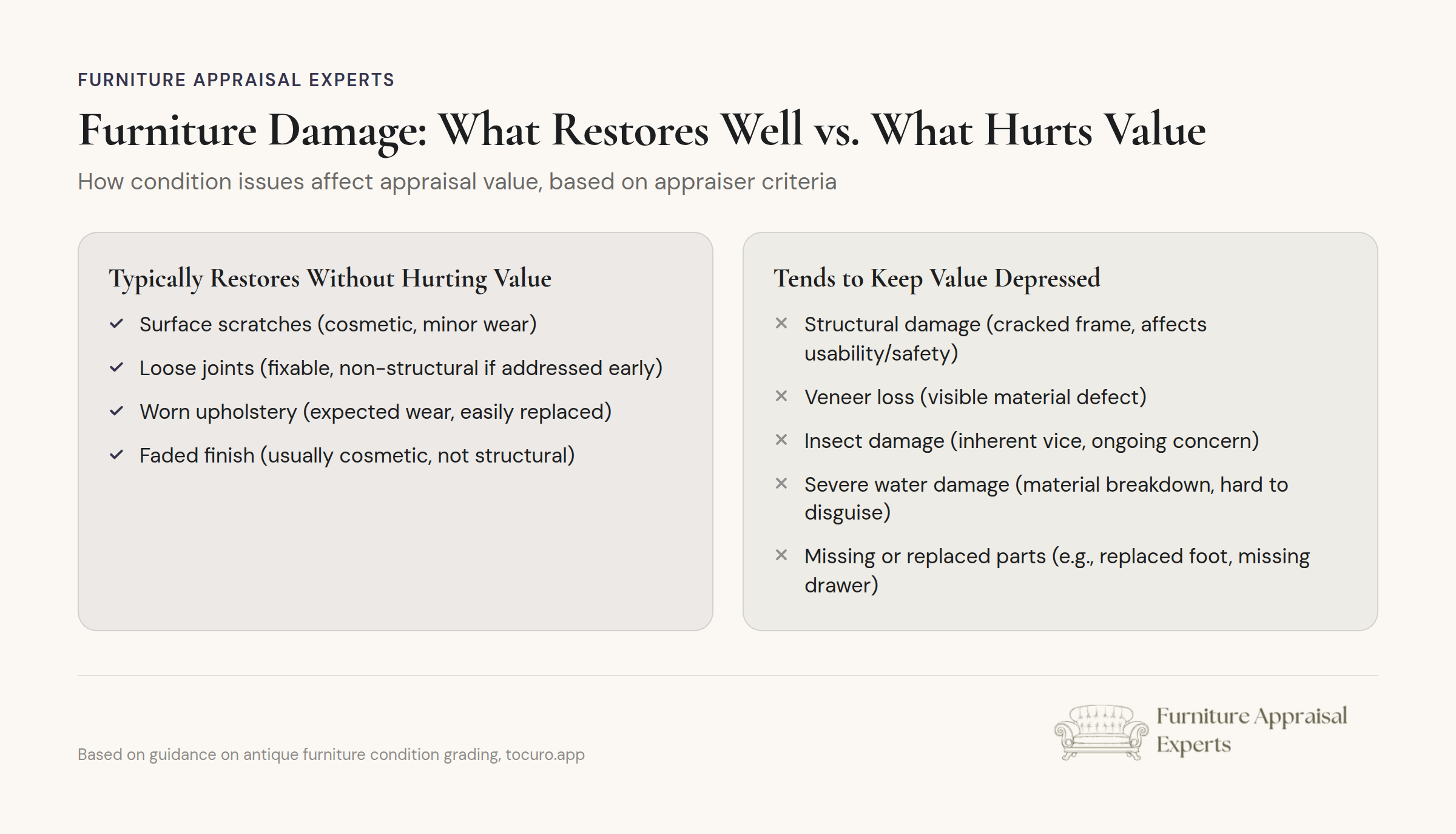
Most of the wear that owners worry about turns out to be the kind that restoration can fully address. Furniture is treated differently than glass or ceramics in this respect: buyers of antique furniture generally expect some repair history, and a well-executed fix rarely counts against the piece the way an obvious crack would on a porcelain vase.
Condition issues that typically restore cleanly include:
- Minor surface scratches, scuffs, or finish wear on a tabletop, arm, or leg
- Small stains that a professional refinish or spot treatment can lift
- Loose joints that a skilled restorer can re-glue and stabilize
- Worn upholstery on a piece where the frame and structure are otherwise sound
- Dulled or cloudy finish from age, sunlight, or humidity exposure
Pro tip: Have an appraiser assess the piece before you commission any repair. A quality restoration on the right kind of damage can leave a piece at least as valuable as it was before the issue occurred, but restoring the wrong way, or restoring something that should have been left alone, can lock in a lower number permanently.
Damage That Typically Keeps Value Depressed
Some condition problems are harder to fully undo, and even a good repair won't return the piece to where it started. These are the issues that tend to show up as a lasting deduction in an appraisal report:
- Structural damage to the frame, legs, or joinery that required significant rebuilding
- Major veneer loss on inlaid or veneered antique pieces, where matching original material is difficult
- Active insect damage, which raises ongoing concerns even after treatment
- Severe water damage that has warped wood or delaminated a finish
- Extensive amateur repairs done before a professional ever saw the piece
The general industry rule is that depreciating property (typical furniture bought for use) usually does not suffer a lasting loss in value after a good repair, while appreciating property (fine antiques, rare or collectible pieces) can suffer a loss of value even when the repair itself is technically well done. A replaced foot on an 18th-century chest, for example, is a permanent mark against the piece no matter how skillfully it was carved and matched, because collectors specifically pay a premium for untouched, original components.
Watch out: Undetectable repairs can still reduce value on appreciating items like fine antiques, even when nobody but an appraiser would ever notice. Disclosure matters as much as workmanship once you're talking about a collectible rather than a functional piece of furniture.
Example: Say a Victorian-era side table would sell for $2,400 in excellent original condition. If a professional restorer replaces a cracked leg with matched, period-appropriate wood, the table might still bring $2,100 to a collector, a modest loss tied to the fact that the leg is no longer original. If that same repair had been done with mismatched wood and visible glue lines, the same table might only bring $1,200, because the poor workmanship compounds the loss from the repair itself.
Getting a Professional Opinion Before You Restore
The safest move with any damaged piece, appreciating or depreciating, is to get a condition assessment before deciding how or whether to repair it. Our furniture appraisal process walks through exactly how that assessment fits into a full valuation, from documentation through the final report.
For standard furniture appraisals, our furniture appraisal service starts at $195 for a standard report and $295 for an IRS-qualified report, with typical engagements running $395 to $2,200 depending on the number of pieces and the depth of research required. More complex or high-value antique furniture can run $1,600 to $3,500 or more. Every engagement is quoted as a fixed fee once we understand the scope of the assignment, never billed by the hour, and our appraisers work in accordance with USPAP so the report holds up for insurance, estate, or resale purposes.
If you're trying to gauge whether a piece is worth a formal appraisal in the first place, our guide on what makes an antique genuinely valuable is a useful starting point before you commit to any restoration work. Condition is only one piece of that picture, but it's often the piece that determines whether a repair helps you or costs you. Read more about our credentialed appraisers, or see more on how condition, age, and provenance affect value.