
Blog
How to Donate Antique Furniture and Claim a Tax Deduction Appraisal
Donating antique furniture to a qualified charity can earn a real deduction, but claims over $5,000 require a qualified appraisal and IRS Form 8283. Here's how fair market value is calculated, what records to keep, and when the appraisal has to reach the IRS.
Donating an antique dresser, dining set, or secretary desk to a qualified charity can lower your tax bill, but the IRS treats used furniture very differently from a cash gift. Claim more than $5,000 for one piece, or for a group of similar pieces donated in the same year, and a receipt from the charity is no longer enough. You need a qualified appraisal and a completed Form 8283 attached to your return. This guide walks through the fair market value rules, the documentation the IRS expects, and the appraisal timing window that trips up more donors than any other part of the process.
When Does Antique Furniture Donation Require a Qualified Appraisal?
A qualified appraisal is required whenever the claimed deduction for a single antique, or a group of similar furniture items donated in the same tax year, is more than $5,000. Below that line, the IRS still expects documentation, just less of it, and the requirements step up in stages as the claimed value rises.
- More than $250: you need a contemporaneous written acknowledgment (CWA) from the charity stating the date of the gift, a description of the item, and whether you received anything in return, per IRS Publication 526.
- More than $500 in total noncash donations for the year: you must attach Form 8283 to your return.
- More than $500 for a single item not in good used condition: furniture donated after August 17, 2006 generally can't be deducted unless it's in good condition or better, but the IRS allows an exception if you obtain a qualified appraisal and attach Form 8283 Section B anyway.
- More than $5,000 for one item or a group of similar items: a qualified appraisal signed and dated by a qualified appraiser is required, along with Form 8283 Section B, signed by both the appraiser and the receiving charity, according to the Form 8283 instructions.
Appraisers who prepare these reports typically hold credentials such as ISA, ASA, or AAA and work in accordance with USPAP, the standards published by The Appraisal Foundation. If you're not sure which tier your donation falls into, our online furniture appraisal service can scope the assignment and tell you before any work begins.
How Is Fair Market Value Calculated for Used Furniture?
Fair market value for donated furniture is not what you paid for it new, minus a percentage for age. It's what a willing buyer would actually pay a willing seller in the current market, with both parties reasonably informed and under no pressure to complete the deal, a standard laid out in IRS Publication 561.
For most household furniture, that number is often surprisingly low. A sofa that cost $2,000 new might be worth $150 to $300 used. Antiques are the exception. A genuine period piece, an item with documented provenance, or a signed piece from a recognized maker can hold or gain value, which is exactly why the IRS wants comparable sales evidence rather than a guess.
For antique furniture, appraisers typically build fair market value from:
- Auction records for the same maker, period, or style.
- Dealer price lists and recent sales of comparable pieces.
- Condition adjustments for veneer loss, replaced hardware, refinishing, or structural repairs.
- Provenance, when documented, which can meaningfully raise value for pieces tied to a notable owner, workshop, or region.
Example: A Federal-period mahogany sideboard purchased decades ago for $3,500 might carry a fair market value of $4,800 today if comparable pieces with matching maker attribution have sold recently at that level, even though the original purchase price is lower.
Pro tip: If your piece has any maker's mark, label, or stamp, photograph it before the appraiser arrives or before you ship photos for a remote review. It's often the single fastest way to narrow the comparable-sales search. If you want a sense of what to look for before you even call an appraiser, our guide on signs of a valuable antique covers the basics.
Watch out: Replacement-cost formulas, like claiming a flat percentage of what a similar new piece costs today, are specifically not an acceptable valuation method for used furniture. The IRS wants market evidence for the actual used item, not a discount off retail.
What Documentation Should You Keep for the Donation?
Keep more than you think you need, because the IRS can request the full file well after you file. At minimum, hold onto the following:
- The written acknowledgment from the charity, showing the date, a description of the item, and confirmation of whether you received anything in return.
- Photographs of the piece from multiple angles, including any maker's marks, damage, or repairs.
- Provenance records, such as prior sale receipts, family documentation, or dealer invoices, if the piece has any documented history.
- Your original purchase records, including how and when you acquired the item and what you paid, which Form 8283 Section A and Section B both ask for.
- The signed qualified appraisal, kept with your tax records even in years where you're not required to attach the full report.
When Must the Appraisal Be Completed and Attached to Your Return?
A qualified appraisal has to be dated within a specific window: no earlier than 60 days before the date you donate the furniture, and no later than the due date, including extensions, of the tax return on which you first claim the deduction, per IRS guidance on qualified appraisal standards. Miss that window on either end and the appraisal doesn't count as qualified, no matter how thorough it is.
For most furniture donations between $5,000 and $500,000, you don't attach the full appraisal report to your return. You complete Form 8283 Section B as the appraisal summary, the appraiser signs Part III, and the charity signs Part V acknowledging receipt. You keep the full appraisal report in your own records in case the IRS asks for it.
The $20,000 attachment rule is specific to art, not furniture generally: if you claim $20,000 or more for a work of art, the IRS requires the full signed appraisal attached to the return, along with a high-resolution photograph on request, under the IRS's art appraisal guidance. Exceptionally valuable antique furniture, museum-grade case pieces or documented maker pieces that cross into five figures, can draw the same level of scrutiny in practice even though the strict rule targets art. The clearer bright line for furniture and other property is $500,000: cross that threshold and the full qualified appraisal must be attached to your return along with Form 8283 Section B.
Deduction Thresholds at a Glance
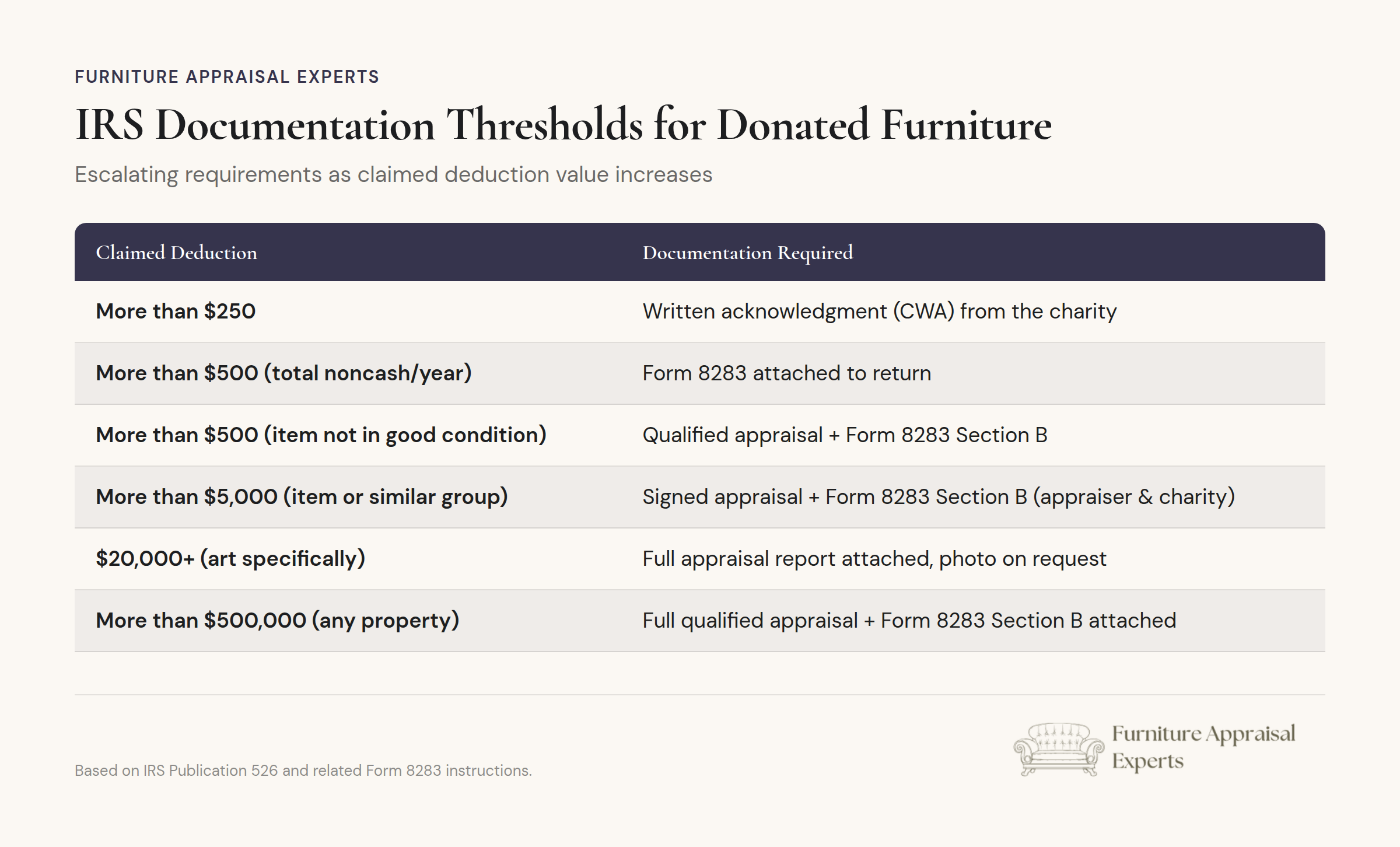
The table below summarizes what triggers at each dollar level, using the thresholds discussed above.
| Claimed Deduction | Requirement |
|---|---|
| More than $250 | Written acknowledgment (CWA) from the charity, per IRS Publication 526 |
| More than $500 (total noncash for the year) | Form 8283 attached to the return |
| More than $500 (single item not in good used condition) | Qualified appraisal plus Form 8283 Section B, as an exception to the good-condition rule |
| More than $5,000 (single item or group of similar items) | Qualified appraisal signed by a qualified appraiser; Form 8283 Section B signed by the appraiser and the charity |
| $20,000 or more (art specifically) | Full appraisal report attached to the return, plus a photograph on request |
| More than $500,000 (any property, including furniture) | Full qualified appraisal attached along with Form 8283 Section B |
What Does a Qualified Furniture Appraisal Cost?
A furniture appraisal built for an IRS-qualified donation deduction is quoted as a fixed fee before any work begins, never billed by the hour. Fee ranges are driven by scope: the number of pieces, how much research the maker or period requires, and whether the report needs to meet the IRS-qualified standard rather than a general reference report.
For furniture, engagements typically start at $195 for a standard report and $295 for an IRS-qualified appraisal, with most single-piece or small-group antique furniture donations running $395 to $2,200 depending on documentation and the depth of comparable-sales research required. Larger or more complex collections, groups of period pieces with provenance research, run higher. If you're donating furniture specifically to support a tax deduction, the IRS-qualified tier is the one that satisfies Form 8283 Section B, not the standard tier.
Protect Your Deduction Before You File
The rules around furniture donations are unforgiving on timing and documentation, but they're not complicated once you know the thresholds. Get a CWA from the charity, photograph the piece before it leaves your possession, and if the claimed value is anywhere near $5,000, get the qualified appraisal lined up before your filing deadline, not after. Our team can request a furniture appraisal scoped specifically for a charitable donation, with the fixed fee quoted upfront and the report timed to your return. Learn more about our independent appraisal practice, or see our FAQ on valuation and reporting.
This article is provided for general informational purposes only and does not constitute legal, tax, or financial advice. Readers should consult a qualified attorney or CPA regarding their specific circumstances.